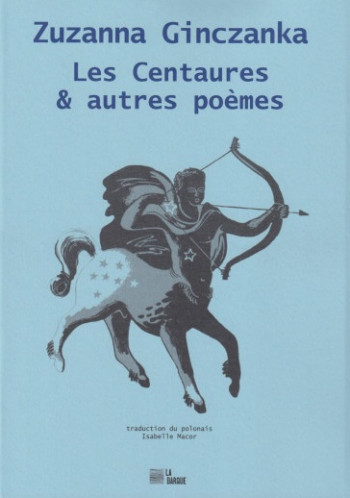
Selected Bibliography:
    Poetry:
  • Komunikat (Communique). Cracow: Wydawnictwo Literackie, 1972.
  • Sklepy miesne (Meat Shops). Cracow: Wydawnictwo Literackie, 1975.
  • Letter: An Ode to Multiplicity. Paris: Instytut Literacki, 1983.
  • Jechac do Lwowa (Travelling to Lwow). London: Aneks, 1985.
  • Plotno (The Canvas). Paris: Zeszyty Literackie, 1990.
  • Ziemia ognista (The Fiery Land). Poznan: a5, 1994.
  • Pragnienie (Desire). Cracow: a5, 2000.
  • Powrót (Return). Cracow: a5, 2003
  • Anteny (Antennae). Kraków: a5, 2005.
  • Niewidzialna ręka, Kraków: Znak, 2009 
  • Wiersze wybrane, Kraków: a5, 2010.
    Novels and Other Prose:
  • Cieplo, zimno (Warm and Cold). Warsaw: PIW, 1975.
  • Cienka kreska (The Thin Line). Cracow: Znak, 1978.
Translations:

Arabic:
  • Të shkosh në Lvov (Jechać do Lwowa i inne wiersze; Dzikie czereśnie: selected poems ), transl. Mazllum Saneja. Prishtinë: Sheshi, 2002.
Czech:
  • Vítr ve větvích [selected poems], Praha: BB/art, 2004.
Dutch:
  • Mystiek voor beginners: gedichten (Selected poems), transl. Gerard Rasch. Amsterdam: Meulenhoff, cop. 2003.
  • Wat zingt, is wat zwijgt: gedichten (Selected poems), transl. Gerard Rasch. Tilburg: Nexus Inst., 1998.
English:
  • Another beauty (W cudzym pięknie), transl. Clare Cavanagh. Athens: Univ. of Georgia Press, 2000.
  • Another Beaty (W cudzym pięknie), transl. Clare Cavanagh. New York: Farrar, Straus and Giroux, 2000.
  • Canvas (Selected poems z: Oda do wielości; Jechać do Lwowa; Płótno), transl. Renata Gorczynski, Benjamin Ivry, C.K. Williams. New York: Farrar, Straus and Giroux, cop. 1991, 1992.
  • Mysticism for beginners, transl. Clare Cavanagh. London: Faber and Faber, 1998.
  • Solidarity, solitude: essays (Solidarność i samotność), transl. Lillian Vallee. New York: The Ecco Press, 1990.
  • Three angels=Trzej aniołowie, transl. Clare Cavanagh [et al.]. Kraków: Wydaw. Literackie, 1998 (Wroc. : WDW).
  • Tremor: selected poems, transl. Renata Gorczynski. London: Collins Harvill, 1987.
  • Tremor: selected poems, transl. Renata Gorczynski. New York: Farrar Straus Giroux, 1985, 1987.
  • Two cities: on exile, history, and the imagination (Dwa miasta), transl. Lillian Vallee. Athens: Univ. of Georgia Press, 2002.
  • Two cities: on exile, history, and the imagination (Dwa miasta), transl. Lillian Vallee. New York: Farrar, Straus, Giroux, [1995].
  • Without end: new and selected poems, transl. Clare Cavanagh, Renata Gorczynska, Benjamin Ivry, and C. K. Williams. New York: Farrar, Straus and Giroux, 2002.
  • A defence of ardor [Obrona żarliwości], New York: Farrar, Straus and Giroux, 2004.
  • Selected poems, London: Faber and Faber, 2004.
  • Eternal Enemies, transl. Clare Cavanagh, USA: Farrar, Straus and Giroux, 2008

French: 

  • Solidarité, Solitude (Solidarność i samotność), transl. Laurence Dyèvre, Editions Fayard, 1986 
  • Coup de crayon (Cienka kreska), transl. Laurence Dyèvre, Editions Fayard, 1987
  • Palissade, Marronniers. Liserons. Dieu (Wybrane wiersze z: List, Oda do wielości ; Jechać do Lwowa i inne wiersze), transl. Maya Wodecka and Claude Durand, Claude Durand Fayard, Paris 1989 
  • La Trahison (Dwa miasta), transl. Laurence Dyèvre, Editions Fayard, 1993
  • Mystique pour débutants, autres poèmes (Ziemia Ognista; Późne święta), transl. Maya Wodecka, Michel Chandeigne, Fayard, Paris 1999 
  • Dans une autre beauté (W cudzym pięknie), transl. Laurence Dyèvre, Fayard 2000
  • La défense de l’ardeur (Obrona żarliwości), transl. Laurence Dyèvre, Fayard 2008 

German:

  • Das absolute Gehör: Roman, transl. Christa Vogel. – Zürich: Unionsverl., 1982.
  • Der dünne Strich: Roman (Cienka kreska), przeł . Olaf Kühl. München: C. Hanser, 1985.
  • Gedichte, transl. Karl Dedecius. München; Wien: C. Hanser, 1989.
  • Ich schwebe über Krakau: Erinnerungsbilder (W cudzym pięknie), transl. Henryk Bereska. München: C. Hanser, 2000.
  • Mystik für Anfänger: Gedichte (Selected poems), transl. Karl Dedecius. München; Wien: C. Hanser, 1997.
  • Stündlich Nachrichten: Gedichte aus zehn Jahren (Selected poems), transl. Karl Dedecius. Berlin: Oberbaum, 1984, 2002.
  • Die Wiesen von Burgung: ausgewählte Gedichte (Selected poems), transl. Karl Dedecius. München; Wien: C. Hanser, 2003.
Hebrew:
  • Mîst.îqā(h) le-mathîlîm (Mistyka dla poczatkujacych), transl. Dāwid Waynpeld (David Weinfeld). Tēl-’Ābîb: Qešeb le-Šîrā(h) ǔ-le-Masā(h), 1999.
Hungarian:
  • Bármi is történt [selected poems], Budapest: Orpheusz, 2004.

Latvian:

  • Svešā skaistumā (Trzej aniołowie, Pragnienie, Ateny), transl. Ingmāra Balode Riga: Satori, 2009
Norwegian:
  • Utsikt over Kraków (Selected poems), transl. Knut Johansen. Oslo: Gyldendal, 1987.
Serbo-Croatian:
  • Mali Larus (Dwa miasta), transl. Biserka Rajčić. Beograd: Stubovi Kulture, 2000.
  • Platno: izabrane pesme (Płótno; Ziemia Ognista; Pragnienie), transl. Biserka Rajčić. Beograd: Stubovi Kulture, 2003.
  • Putovati u Lavov (Jechać do Lwowa), transl. Petar Vujičić. Beograd: Narodna Kniga, 1988.
Slovak:
  • Divé čerešne (Dzikie czereśnie), transl. Karol Chmiel. Bratislava: F. R. and G., 1994.
Slovenian:
  • Mistika za začetnike: [izbrane pesmi], transl. Niko Jež. Ljubljana: Cankarjeva Založba: Društvo Sloven. Pisateljev, 1997.

Spanish:

  • En la belleza ajena (W cudzym pięknie), transl. Ángel Enrique Díaz-Pintado Hilario. Valencia: Pre-Textos, 2003.
  • Tierra del fuego (Ziemia Ognista), transl. Xavier Farré, Barcelona: Acantilado, 2004
  • Terra del foc (Ziemia Ognista), transl. Xavier Farré, Barcelona: Quaderns Crema, 2004
  • En defensa del fervor (W obronie żarliwości), transl. J. Slawomirski i A. Rubió, Barcelona: Acantilado, 2005
  • Deseo (Pragnienie), transl. Xavier Farré, Barcelona: Acantilado, 2005
  • Dos ciudades (Dwa Miasta), transl. J. Slawomirski i A. Rubió, Barcelona: Acantilado, 2006
  • Antenas (Anteny), transl. Xavier Farré, Barcelona: Acantilado, 2007

Swedish:

  • Elektrisk elegi: och andra dikter (Selected poems), transl. Anders Bodegård. Stockholm: Norstedts, 1993.
  • Ode till mångfalden: och andra dikter (List, Oda do wielości), transl. Anders Bodegård, Lars Kleberg. Höganäs: Bra Lyrik, 1987.
  • Törst (Selected poems), transl. Anders Bodegård. Stockholm: Norstedts, 2003.
  • Två städer (Dwa miasta), transl. Anders Bodegård. Stockholm: Norstedts, 1991.

Zagajewski Adam

Born in 1945, a poet, novelist, essayist and the winner of many prestigious literary prizes. He was born in Lwow but never lived there: his parents were repatriated to Poland shortly after his birth. He spent his childhood in Gliwice, in Silesia. He became well known as the leading poet of the "Generation of 1968". He took part in the unofficial literary movement of the 1970s, and moved to Paris in 1982. He joined the staff of Zeszyty Literackie there. He has also lectured on creative writing at the University of Houston. His first collections of poetry, Communique (1972) and Meat Shops (1975), carried out his generation's program of speaking the truth about the public realities around him and exposing the falsity of the official language. His volume Letter: An Ode to Multiplicity (1982) included poems that reacted to the imposition of Martial Law, but also contained those themes that were to become a permanent feature of Zagajewski's work: meditative poems full of question marks and essays written by a "problematic person". Zagajewski's standard poetic themes include a constant questioning of the biographical-existential role of the protagonist of lyric poetry, and praise for life viewed in "its changeability, its pulsation, its ambiguity" (as he wrote in Solidarity and Solitude (1986). Other themes are immersion in European culture and the contemplation of its heritage, reaching into the depths of his own roots (the poem Traveling to Lwow, 1985), and the exploration of variations on his own fate by trying on costumes and masks. A frequently recurring image in Zagajewski's poems is that of a pensive wanderer with a book in his hand, traveling through a world "borrowed from the great library" (The Canvas, 1986). Similar themes are found in his prose. The novel Warm and Cold (1975) recounts the passage into adult life and exposure to temptation of a young intellectual: he is tormented by doubts and by an inability to opt for a world of unambiguous principles. As a result, he begins to serve the police state. The subsequent novels The Thin Line (1983) and Absolute Pitch (published only in German translation) recount the spiritual conundrums of the contemporary artist. "I understood that the world is double, divided, splendid and trivial at once, ponderous and feathery, heroic and cowardly," a communist functionary finally admits in the short story "Treason" in the collection Two Cities, 1991. Zagajewski's essays present the world in a similar way. After the youthful literary manifesto The Unpresented World (1974), they become a series of chapters in the author's spiritual autobiography. Solidarity and Solitude (1986) highlights the pathologies and illusions of a culture too deeply involved in politics while weighing the dilemmas that face writers and artists today. The prose and mini-essays in Two Cities and In the Beauty of Others (1998) contain philosophical deliberations and reflections on reading and travelling through Europe. Zagajewski writes about Cracow and about Paris, about the cities of his childhood and the mythical cities of his "Central European" education, about Nietzsche, Junger, Bruno Schulz, Cioran, and Gottfried Benn, as well as about the dangers that our society presents to spiritual life and the paradoxes that arise when there are more and more informational media and less and less information worth conveying, as well as many other issues and figures who are crucial to our modern times.

I will never be someone who writes only about bird song, although I admire birdsong highly - but not enough to withdraw from the historical world, for the historical world is fascinating. What really interests me is the interweaving of the historical and cosmic world. The cosmic world is unmoving - or rather, it moves to a completely different rhythm. I shall never know how these worlds coexist. They are in conflict yet they complement each other - and that merits our reflection (Adam Zagajewski)


Back


author
books
excerpts
news


Name:
Email:


There are more than 28,000 publishers registered in Poland. However, the market is highly concentrated. The 200 largest publishing firms still hold almost 98 per cent of it. More »

© 2003-2010 Instytut Książki Design by